SMS Widgets for Dashboards & Reporting

Modified on: Wed, 3 Jun, 2026 at 7:58 AM

Track every SMS your team sends and receives — without leaving HighLevel. SMS Widgets bring dedicated messaging analytics directly into your Sub-Account Dashboard and Custom Reports, giving agencies and their clients a clear picture of SMS volume, delivery health, source activity, and team performance.


TABLE OF CONTENTS


What Are SMS Widgets?


SMS Widgets are pre-built visual reporting blocks that surface SMS messaging data directly inside any HighLevel Sub-Account Dashboard or Custom Report. They work exactly like Email Widgets — no manual exports, no filtering through Conversations — just clean, real-time SMS analytics wherever you need them.


With five dedicated widgets covering delivery status, inbound volume, source type, sender performance, and time-based trends, you can build an SMS health view for clients in minutes and share it on a schedule.


Key Benefits of SMS Widgets

  • Monitor delivery health — See exactly how many messages were Sent, Delivered, Failed, Pending, Undelivered, Clicked, or Read without digging through Conversations manually
  • Track SMS volume over time — SMS volume over time shows day/week/month breakdowns so you can monitor usage trends and plan capacity confidently
  • See where messages originate — Filter by Source (Workflow, Campaign, Bulk action, Other) to understand what is driving SMS usage
  • Hold teams accountable — SMS by sender shows outbound volume per team member, giving managers visibility into individual activity and workload
  • Close the loop on inbound — Incoming SMS count tracks replies and inbound messages so you can measure two-way conversation engagement
  • Precise control with AND/OR conditions — Stack multiple filters across Status, Direction, Source, Sent by, and Workflow to segment exactly the data you need

Prerequisites & Access

- Dashboards & Reports access: verify the user has permission to view or edit dashboards and to create or schedule Custom Reports

- No additional integration or connection is required — SMS data is already available inside HighLevel


Available SMS Widgets


Five SMS widgets are available, each configurable with chart type, conditions, and themes.

WidgetWhat Data It Shows
SMS by statusDistribution of outbound SMS by delivery status — Sent, Delivered, Failed, Pending, Undelivered, Clicked, Read. Use this to monitor messaging health and identify delivery issues early
Incoming SMS countCount of inbound SMS messages received. Filter by Direction (Inbound/Outbound) and date range to track reply volume and two-way conversation trends
SMS by source typeOutbound SMS broken down by the source that triggered the send — Workflow, Campaign, Bulk action, or Other. Understand what is driving your SMS volume.
SMS by senderOutbound SMS volume grouped by the team member (Sent by) who sent the message. Track individual activity and workload across your team
SMS volume over timeTrend of total SMS sent over time — view by day, week, or month. Ideal for tracking usage trends, capacity planning, and client reporting


Widgets in Dashboard, Custom Report, Custom Metrics

In all 3 environments use the five SMS widgets. Choose based on how you need to view, and compute and share data.


  1. Dashboard — Best for always-on monitoring. Widgets live on a Sub-Account dashboard and update automatically. Build an SMS health section alongside your Email and Calls widgets for a full messaging overview
  2. Custom Reports — Best for scheduled client delivery. Add SMS widgets to a report layout and schedule automatic email delivery on a daily, weekly, or monthly cadence
  3. Custom Metric - Build a custom metric to build your own KPI not just SMS metric, also combine with other modules as well


How to Add SMS Widgets

1) Add SMS Widgets to a Dashboard


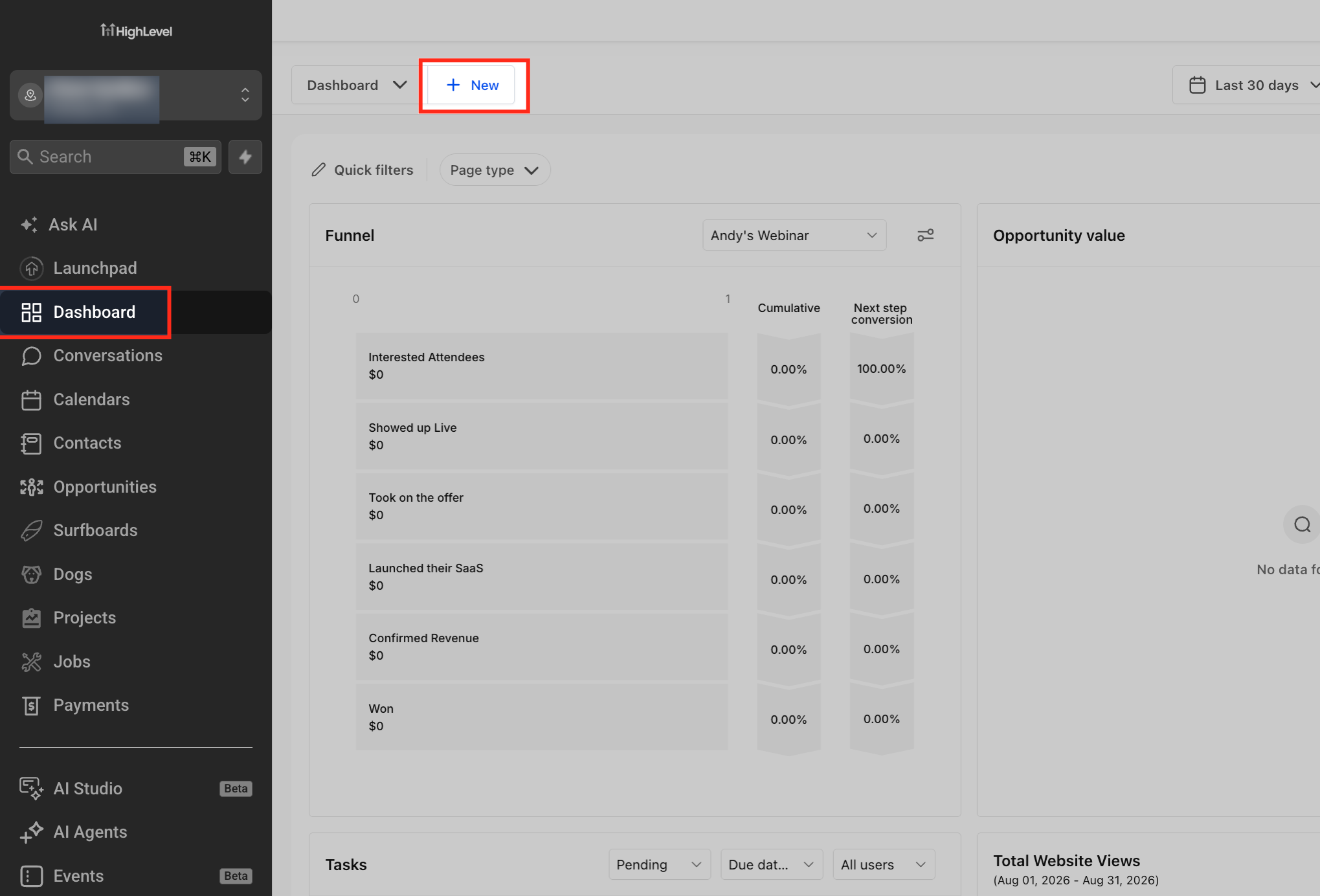
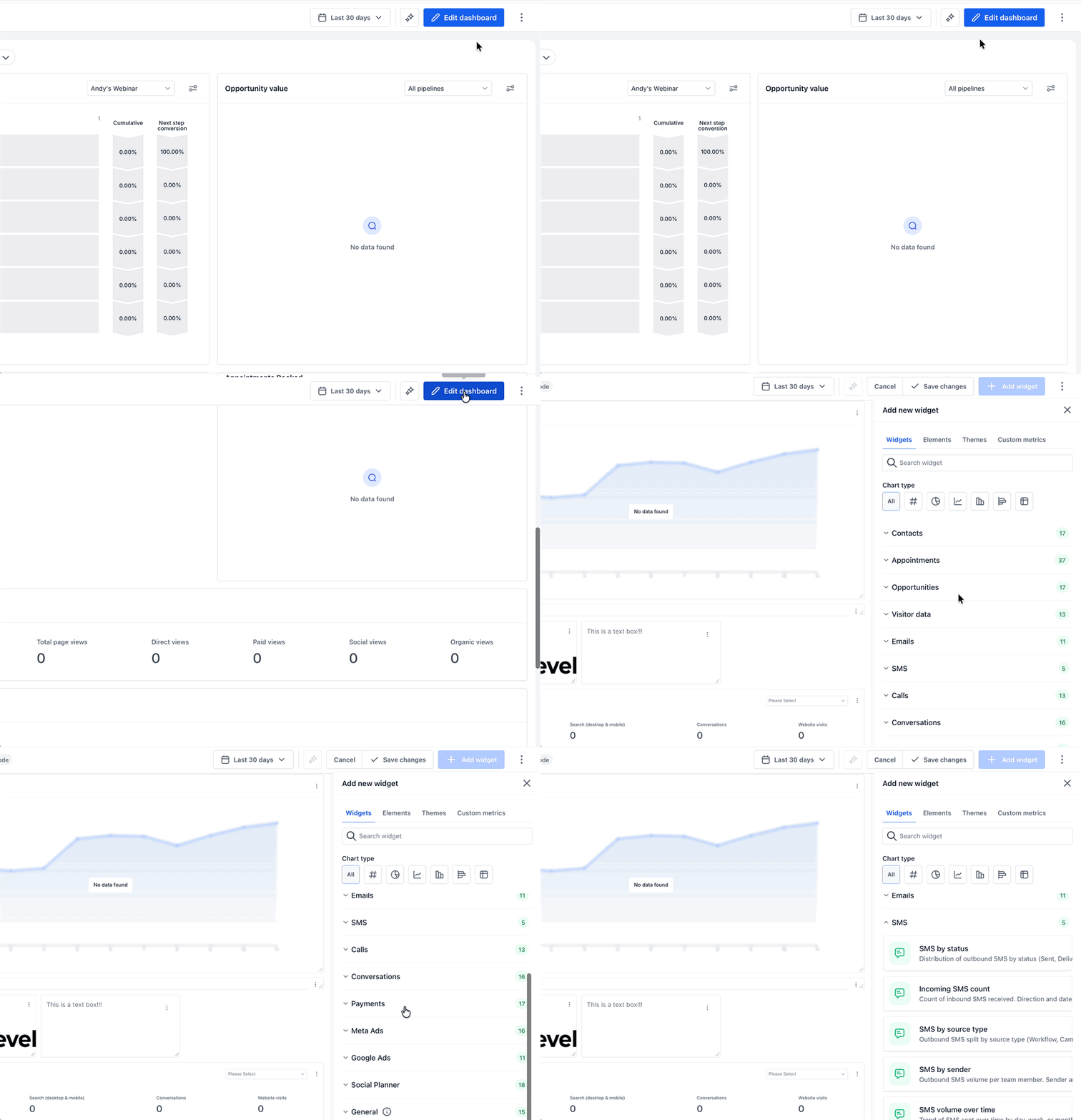
1. In your Sub-Account, navigate to Dashboards and open the dashboard you want to edit (or create a new one)

2. Click Edit Dashboard in the top right corner

3. Click + Add Widget — the widget panel opens on the right side

4. Scroll down to the SMS section (below Emails) — all 5 SMS widgets are listed here

5. Click on the widget you want to add — it is placed on your dashboard canvas

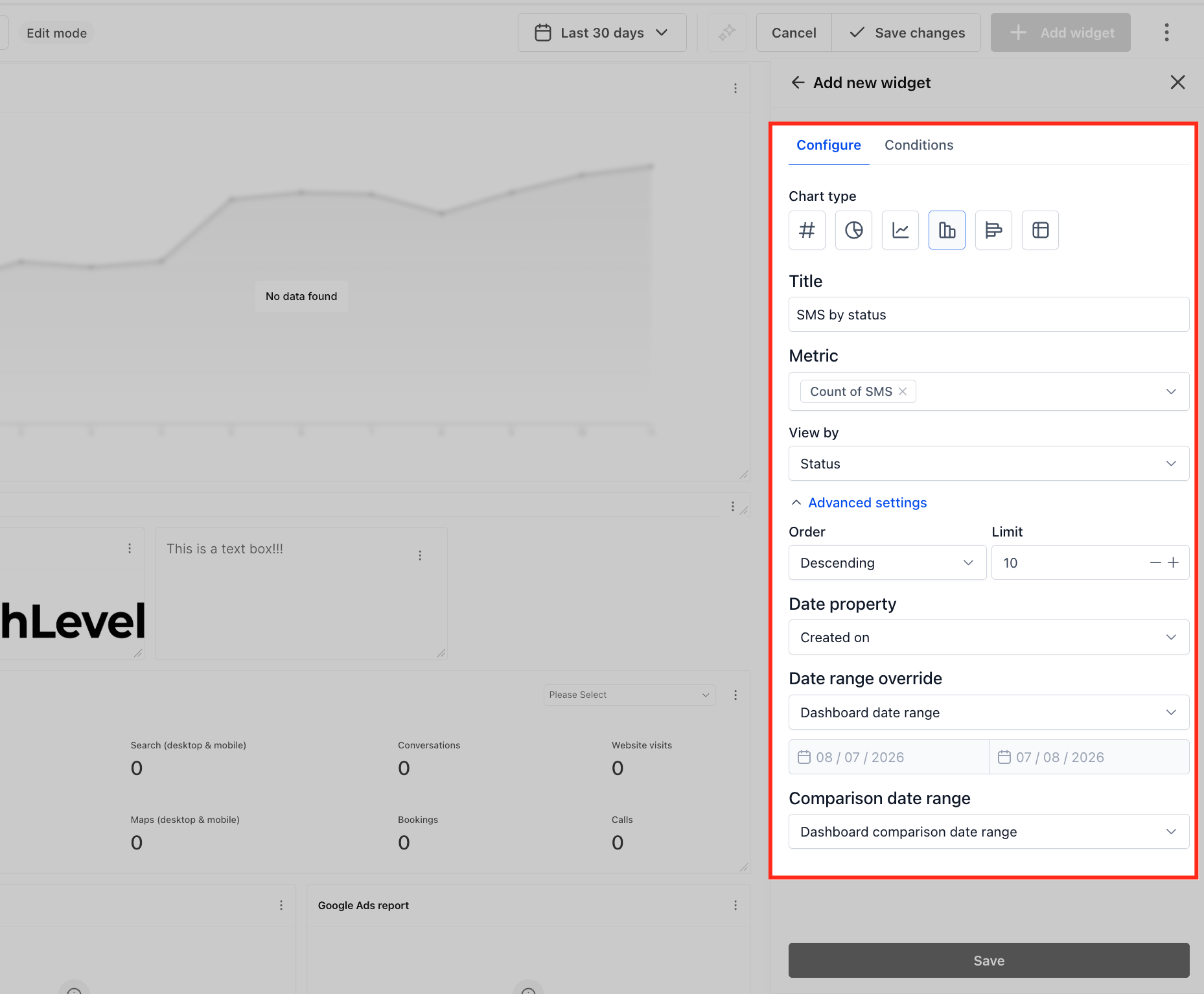
6. Configure the widget using the Configure, Conditions, and Themes tabs (see below)

7. Click Save Changes to publish the widget to your dashboard


> Tip: Add SMS volume over time and SMS by status side by side for a quick SMS health view at the top of your dashboard.


2) Add SMS Widgets to a Custom Report


1. In your Sub-Account, go to Reporting → Custom Reports and open an existing report or click New Report

2. Choose to start from a blank canvas, use a template, or import an existing dashboard layout

3. Click Add Widget / Element in the top left of the report builder

4. Scroll to the SMS section and drag the widgets you want into your report layout

5. Configure each widget using the Configure, Conditions, and Themes tabs

6. Click Save

7. Click Send or Schedule to set up automatic email delivery of the report


Configuring SMS Widgets


Each SMS widget has three configuration tabs in the Edit Widget panel.


Configure Tab

The Configure tab controls how the widget looks and what data dimension it groups by.

  • Metric - Count of SMS
  • Group - Controls how widget data is broken down visually. Options: Status, Direction, Source, Sent by — and conditionally: Workflow, Campaign, Bulk action (see note below)


 ⚠️ How to unlock Workflow, Campaign, and Bulk action in Group:


 Workflow, Campaign, and Bulk action appear greyed out in the Group dropdown by default. To activate them:


 1. Go to the Conditions tab first

 2. Add a Source filter and set its value (e.g. Source = Workflow)

 3. Make sure all condition branches use the same Source value

 4. Return to the Configure tab — the matching Group option is now active


 This allows you to break down widget data by the specific workflow, campaign, or bulk action that triggered each SMS. For example: set Source = Workflow in Conditions, then Group by Workflow in Configure to see SMS volume broken down per workflow.


Conditions Tab

Add filters to control exactly which SMS data the widget displays. Conditions support AND / OR logic — stack multiple filters to narrow or expand your dataset.


? [SCREENSHOT: Conditions tab showing AND/OR logic with Source = Workflow AND Workflow = specific workflow OR Source = Campaign]


ConditionValuesNotes
StatusSent, Delivered, Failed, Pending, Undelivered, Clicked, ReadFilter outbound SMS by delivery outcome
DirectionInbound, OutboundFilter by message direction
SourceWorkflow, Campaign, Bulk action, OtherFilter by what triggered the SMS send
Sent byLogged in user, or any team member in the sub-accountFilter outbound SMS by the sender


How AND/OR conditions work:

  • Use + AND to narrow results — all conditions in a group must be true
  • Use OR to add a separate condition group — either group can be true 
  • Example: Source = Workflow AND Workflow = "Lead Nurture" OR Source = Campaign — shows SMS from one specific workflow or from all campaigns

Themes Tab

Match widget colors to your dashboard or client brand. Select from available theme presets or customize colors.


? [SCREENSHOT: Themes tab with color options]


Using SMS in Custom Metrics


SMS is already available as a dimension in Custom Metrics. Use Count of SMS in the formula builder to create KPIs that combine SMS data with other metrics.


? [SCREENSHOT: Create Custom Metric screen with Count of SMS selected in formula builder and Configuration panel open showing Status and Direction filters]


How to use Count of SMS in a Custom Metric:


1. Go to Dashboards → Edit Custom Metrics and click Create Custom Metric

2. In the Formula builder, select Count of SMS as your metric (supports up to 4 metrics combined with operators)

3. Click on Count of SMS in the formula to open the Configuration panel on the right

4. Under Filters, add conditions to refine which SMS are counted:

   - Status — e.g. Status Is Delivered to count only delivered messages

   - Direction — e.g. Direction Is Inbound to count only replies received

   - Use + AND and OR to combine multiple filters

5. Name your metric, set Data Type, and click Create


Example KPIs you can build in custom metric:

- SMS Delivery Rate — Count of SMS (Status = Delivered) ÷ Count of SMS (Status = Sent) × 100

- Inbound SMS Volume — Count of SMS (Direction = Inbound)

- Campaign SMS Sent — Count of SMS (Source = Campaign)


Frequently Asked Questions


Q: Do SMS Widgets cover both outbound and inbound messages?

Yes. Incoming SMS count is specifically for inbound messages. SMS by status, SMS by source type, SMS by sender, and SMS volume over time cover outbound. Use the Direction condition to filter any widget to Inbound or Outbound.


Q: What are all the Status values available?

Sent, Delivered, Failed, Pending, Undelivered, Clicked, and Read.


Q: What are the Source options?

Workflow, Campaign, Bulk action, and Other.


Q: How does the Workflow condition work?

Select Source = Workflow first, then a second condition row appears where you can select a specific workflow from your sub-account.


Q: How do I group a widget by a specific Workflow or Campaign?

First go to the Conditions tab and set Source = Workflow (or Campaign) across all condition branches. Then return to the Configure tab — Workflow (or Campaign) will now be active in the Group dropdown. Select it to break down the widget data by that source type.


Q: Why is Workflow greyed out in the Group dropdown?

Workflow, Campaign, and Bulk action in the Group dropdown only activate when a matching Source filter is set in the Conditions tab. See the Configure Tab section above for the full steps.


Q: Why is my SMS widget showing no data?

Common causes: the selected date range has no SMS activity, filters are too narrow, or SMS has not been used in this sub-account. Try removing conditions or widening the date range.


Q: Can I combine SMS widgets with Email and Calls widgets on the same dashboard?

Yes. All messaging categories — SMS, Emails, and Calls — can be placed on the same dashboard for a unified communication health view.


Q: Can I schedule an SMS report for clients?

Yes. Add SMS widgets to a Custom Report and schedule automatic email delivery on a daily, weekly, or monthly cadence.


Q: Is SMS available in Custom Metrics?

Yes. Count of SMS is already available in the Custom Metrics formula builder. You can filter by Status, Direction, Source, and Sent by to build precise KPIs like delivery rate or inbound volume.


Q: How often do SMS widgets update?

Widgets update automatically. No manual refresh is needed.


Q: Which plans include SMS Widgets?

SMS Widgets are available on all plans that include Dashboards & Reporting.


- [Email Widgets](https://help.gohighlevel.com/support/solutions/articles/155000004328-email-widgets)

- [What Are Dashboard Widgets?](https://help.gohighlevel.com/support/solutions/articles/155000001212-what-are-dashboard-widgets-)

- [How To Create A Custom Dashboard](https://help.gohighlevel.com/support/solutions/articles/155000001531-how-to-create-a-custom-dashboard)

- [How to Create and Schedule Reports](https://help.gohighlevel.com/support/solutions/articles/155000001210)

- [Dashboards: Meta Ad Widgets and Insights](https://help.gohighlevel.com/support/solutions/articles/155000006608-dashboards-meta-ad-widgets-and-insights)


Was this article helpful?

That’s Great!

Thank you for your feedback

Sorry! We couldn't be helpful

Thank you for your feedback

Let us know how can we improve this article!

Select at least one of the reasons
CAPTCHA verification is required.

Feedback sent

We appreciate your effort and will try to fix the article