If you've purchased an IP subscription, you now have access to IP Status Monitoring through a Microsoft SNDS (Smart Network Data Services) integration. This lets you track your IPs' deliverability health on Microsoft platforms and catch potential issues before they hurt your sending reputation.
What is Microsoft SNDS?
Microsoft SNDS is a tool that provides insight into the email activity of your IPs on Microsoft platforms, such as Outlook and Hotmail. It reports on IP health, spam complaints, filter results, and blocked status — giving you the information you need to keep your emails landing in the inbox instead of the spam folder.
How to Use the IP Status Feature
Navigate to Settings → Email Services → Postmaster Tools → Microsoft SNDS.
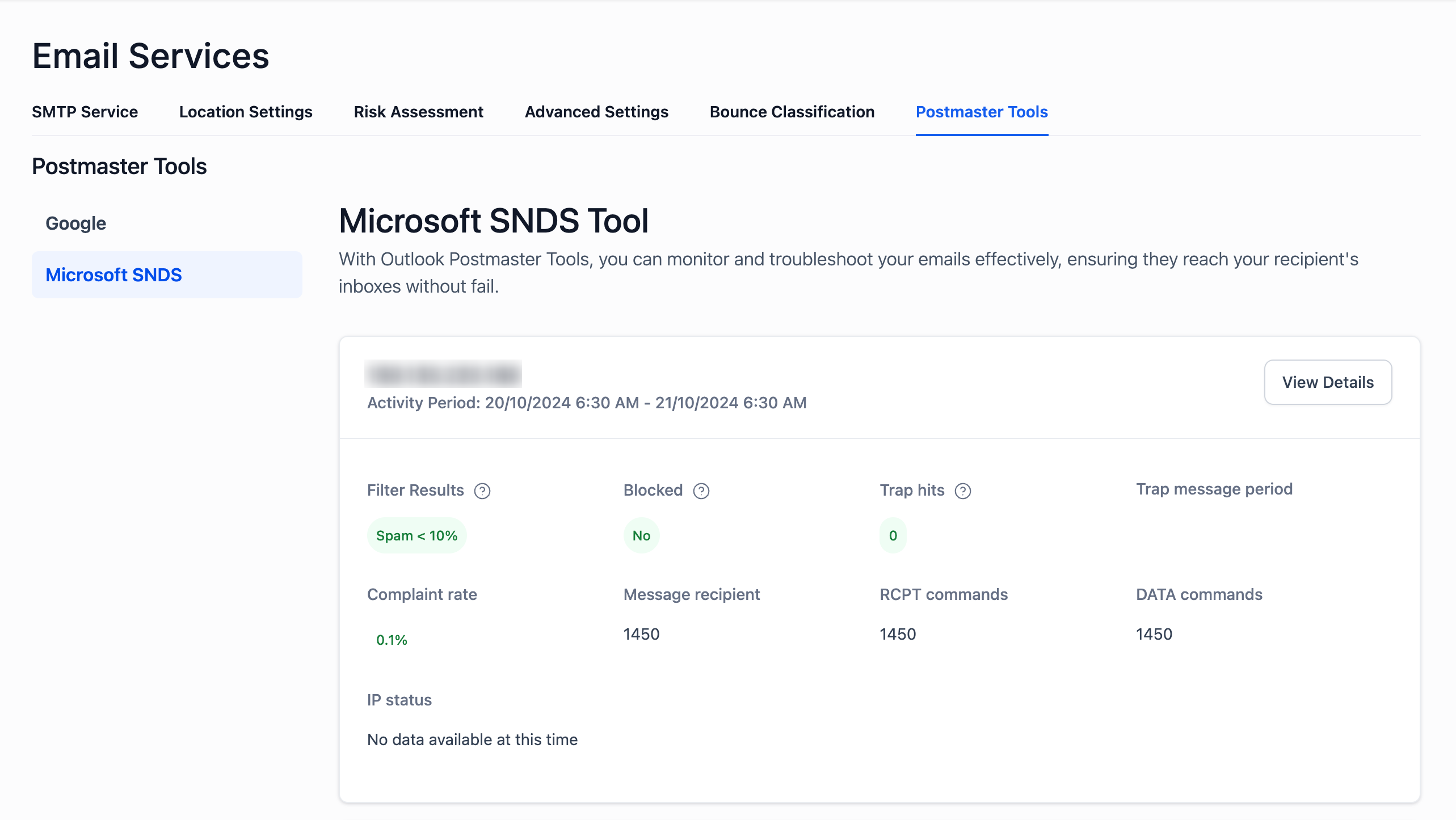
You'll see a list of your IPs with metrics including:
- Filter Results — the percentage of messages flagged as spam.
- Blocked Status — whether the IP is blocked on Microsoft platforms.
- Trap Hits — the number of messages flagged by spam traps.
- Complaint Rate — the percentage of recipients who reported your emails as spam.
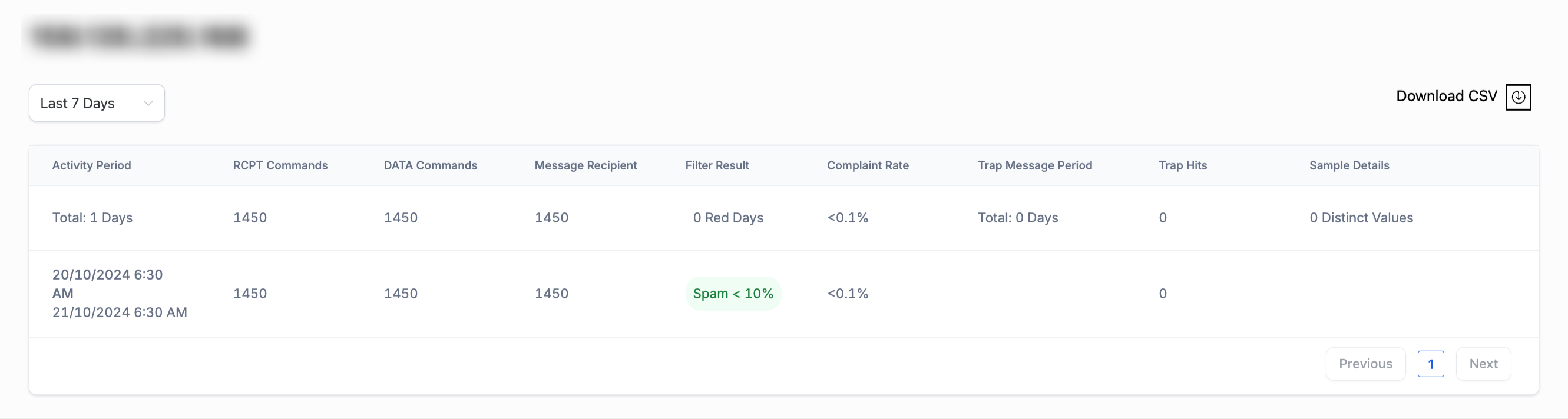
Click View Details for an in-depth look at the selected IP, including:
- Activity Period — the timeframe of email activity.
- RCPT Commands and DATA Commands — the volume of messages processed.
- Spam and Complaint Rates — helps you understand the IP's reputation.
For advanced reporting, click Download CSV to export detailed activity for further analysis.
Interpreting Key Metrics
| Metric | Healthy Range | What It Means |
|---|---|---|
| Filter Results | Below 10% spam | 10% or higher means some emails are being classified as spam. Review your sending practices, content, and lists. |
| Blocked Status | No | "Yes" means your IP is blocked due to possible spam behavior or policy violations and needs immediate attention. |
| Trap Hits | 0 | One or more hits suggests your list contains invalid or suspicious addresses that should be cleaned. |
| Complaint Rate | Below 0.1% | Above 0.1% means recipients are marking your emails as spam. Review your content and confirm opt-in. |
| RCPT Commands | Aligned with volume | Total recipients who received your emails. Monitor to ensure volume matches your expected campaign size. |
| DATA Commands | Aligned with volume | Total data payloads processed, reflecting messages transmitted. Keep consistent with planned sends to avoid triggering filters. |
| Trap Message Period | 0 days | Number of days your emails were detected by spam traps. Any non-zero value requires immediate investigation. |
| Red Days (Filter Result Issues) | 0 | One or more red days means some days had higher spam rates or deliverability issues. Investigate the sending patterns for those periods. |
Check these metrics regularly rather than only after a deliverability problem shows up — catching a rising complaint rate or a Red Day early makes it much easier to fix before it affects your inbox placement.
How to Handle IP Blocking or High Spam Rates
If your IP is blocked or shows a high spam rate, work through these steps:
Analyze recent activity, especially around trap hits and complaints.
Remove invalid or inactive addresses and confirm that all recipients have opted in.
If your IP is blocked, submit a delisting request using the Microsoft Outlook Support page.
Blocked IPs and non-zero Trap Message Periods require immediate action — the longer a sending issue goes unaddressed, the harder it is to rebuild your reputation with Microsoft.
Frequently Asked Questions
Was this article helpful?
That’s Great!
Thank you for your feedback
Sorry! We couldn't be helpful
Thank you for your feedback
Feedback sent
We appreciate your effort and will try to fix the article