This article will show you how to use the improved Add Guests features in HighLevel’s calendar bookings. You can now require guest information and charge payments based on total attendee count—making it well-suited for group sessions, classes, or any service involving multiple participants.
TABLE OF CONTENTS
- Overview of Adding Guests in Calendar Bookings
- Key Benefits of Add Guests to Bookings
- How To Enable Add Guests Features
- Require Guests for Booking
- How Guest Contacts Are Created
- Guest Contact Timezones
- Collect Payment for All Attendees
- Frequently Asked Questions
- Related Articles
Overview of Adding Guests in Calendar Bookings
The Add Guests feature allows customers to include additional attendees during the appointment booking process. This ensures the business has a complete list of all individuals participating in the session. With recent enhancements, Add Guests now supports mandatory guest entry and automatic payment calculation based on total attendee count.
These upgrades are especially useful for businesses where multiple attendees are standard, such as therapy practices, fitness classes, group consultations, or restaurants.
Key Benefits of Add Guests to Bookings
Gain greater control over group bookings while minimizing errors in guest data and payment processing.
Collect accurate payments based on the total number of attendees.
Choose whether to collect guest email addresses, phone numbers, or both.
Collect only the guest count when individual guest contact details are not needed.
Create or match guest contacts using the email address and/or phone number provided during booking.
Display complete guest lists in appointment records when guest details are collected.
Track attendance and group sizes more effectively.
Minimize payment confusion and reduce support inquiries.
How To Enable Add Guests Features
Use the Calendar settings to activate both guest collection and attendee-based payment options.
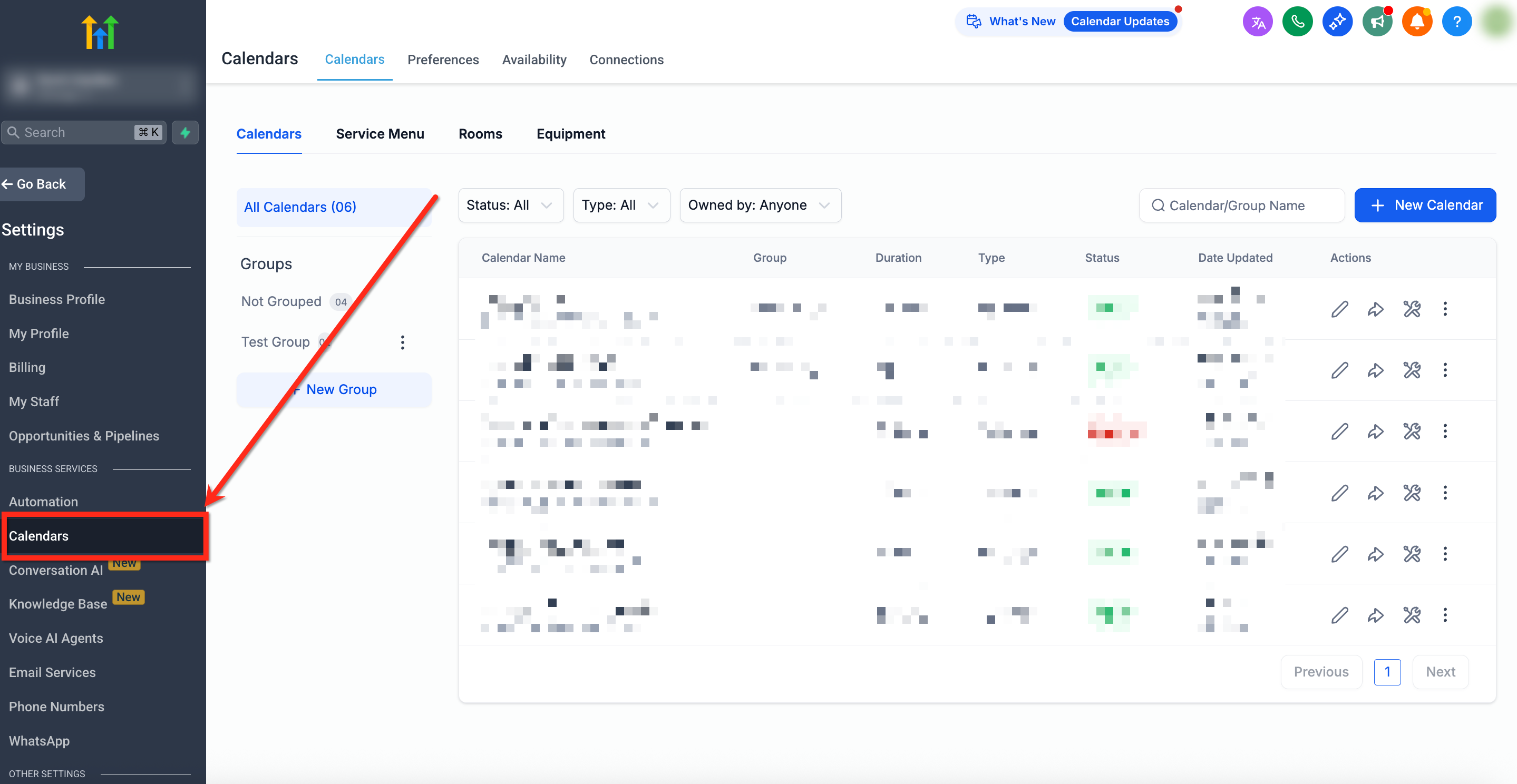
- Navigate to Settings > Calendars in your HighLevel dashboard.
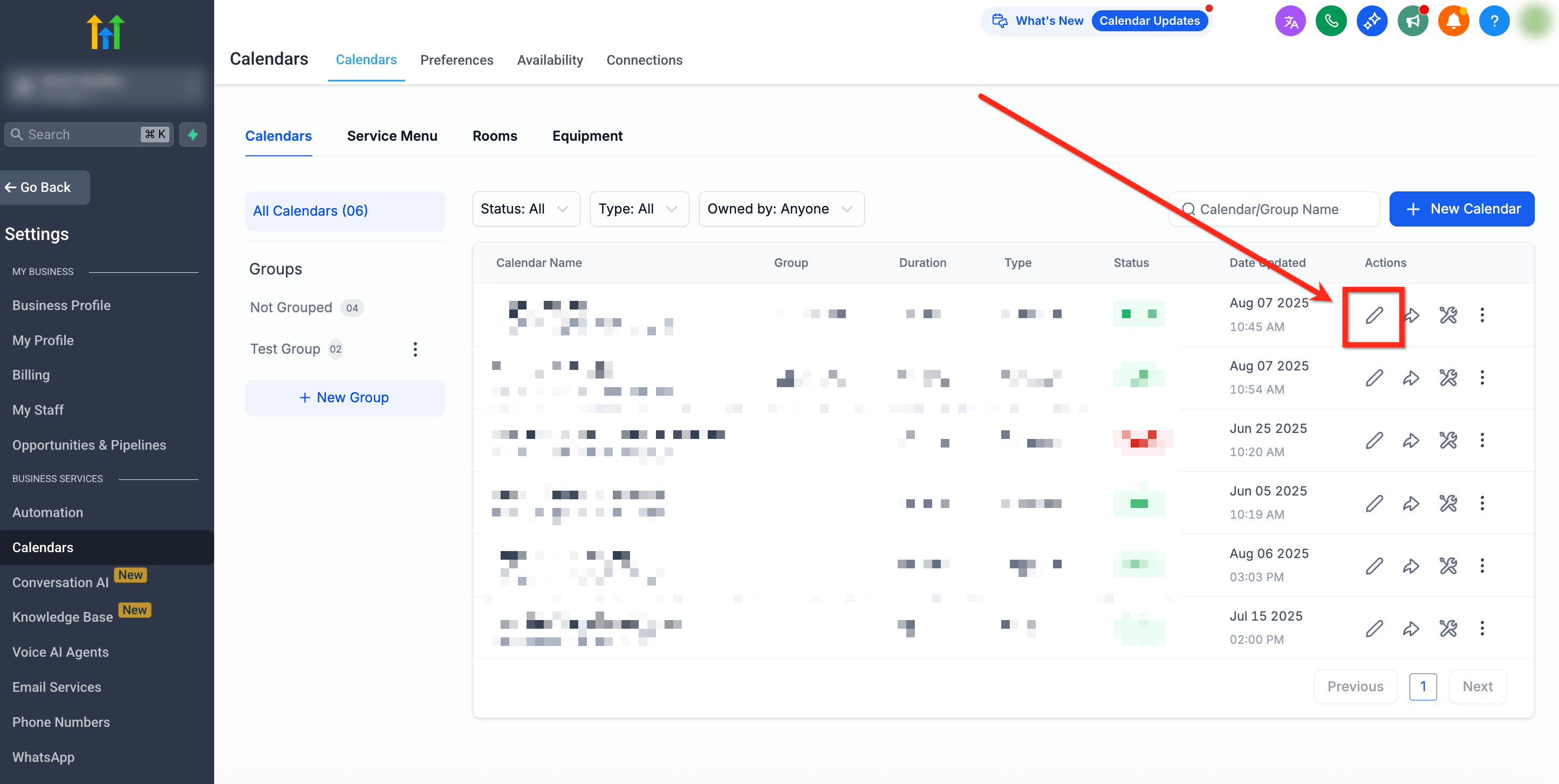
- Click Edit next to the calendar you want to modify.
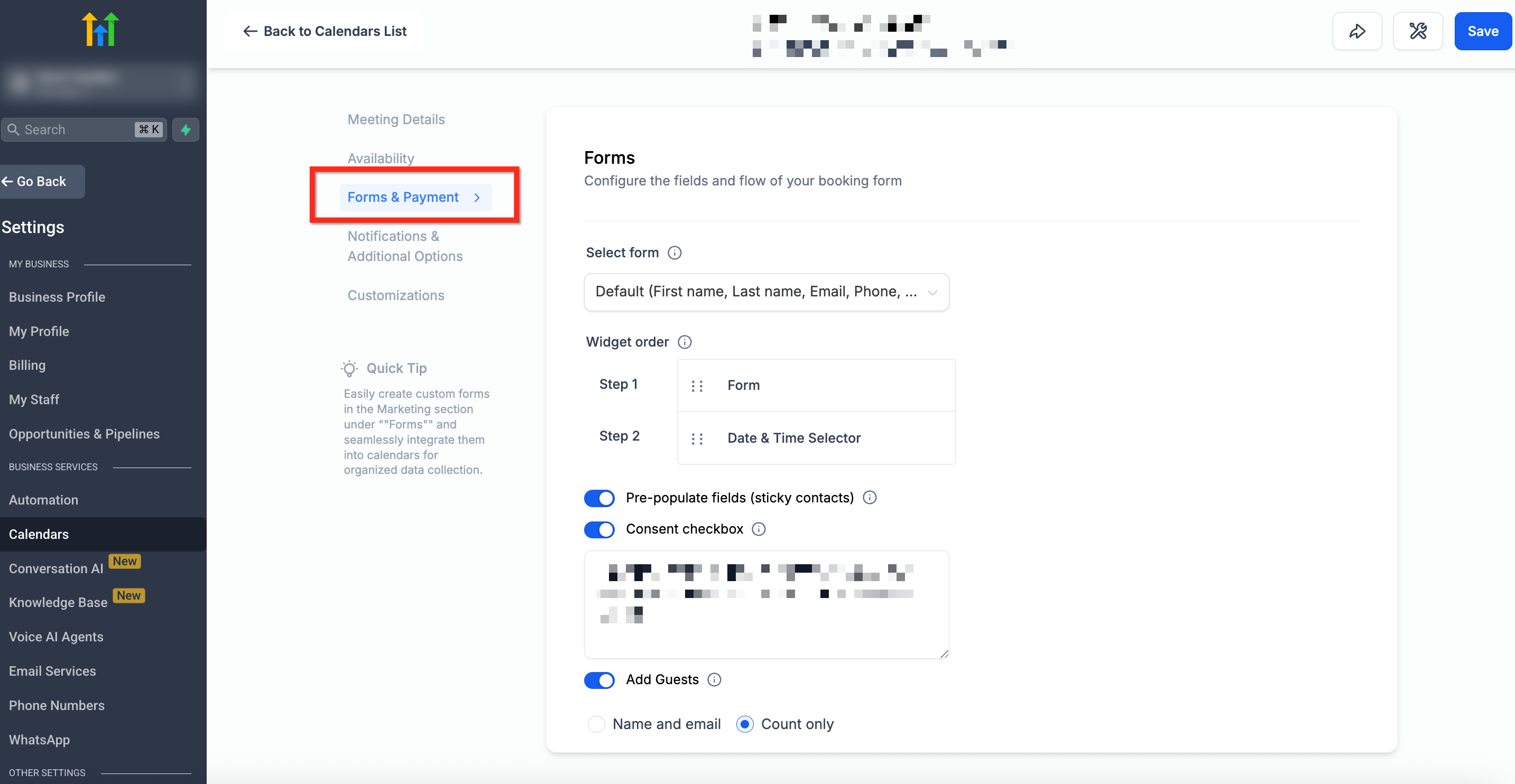
- Open the Forms & Payment tab.
- Scroll to the Add Guests section. Toggle on Require Guests for Booking to make guest information mandatory.
Choose which information to collect for each guest:Name & Email — Collect the guest's name and email address.
Name & Phone — Collect the guest's name and phone number.
Name, Email & Phone — Collect all three guest details.
Guest Count Only — Collect only the number of guests without creating individual guest contacts.
Note: Existing calendars that already collect guest details continue using Name & Email. New calendars default to Name, Email & Phone.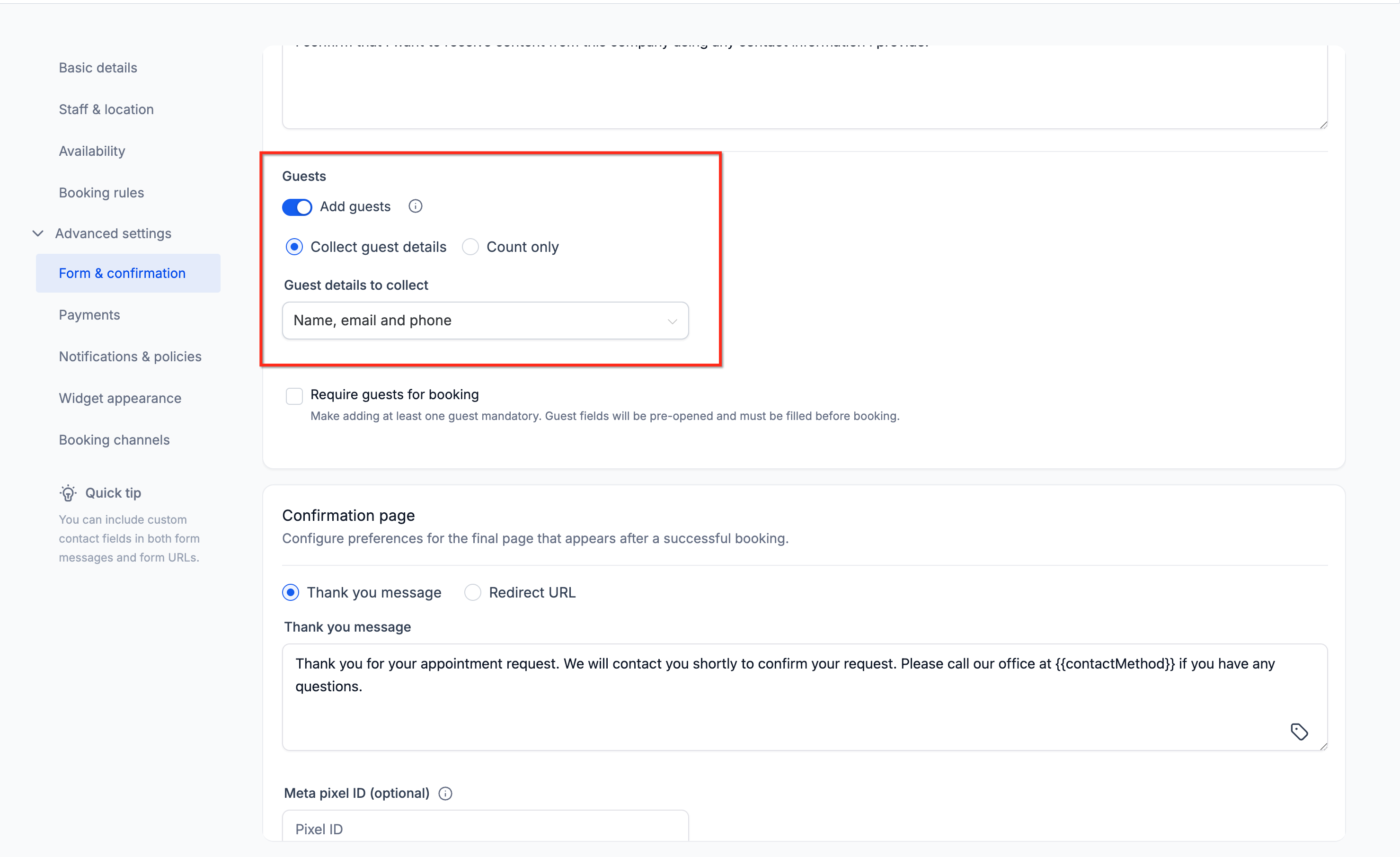
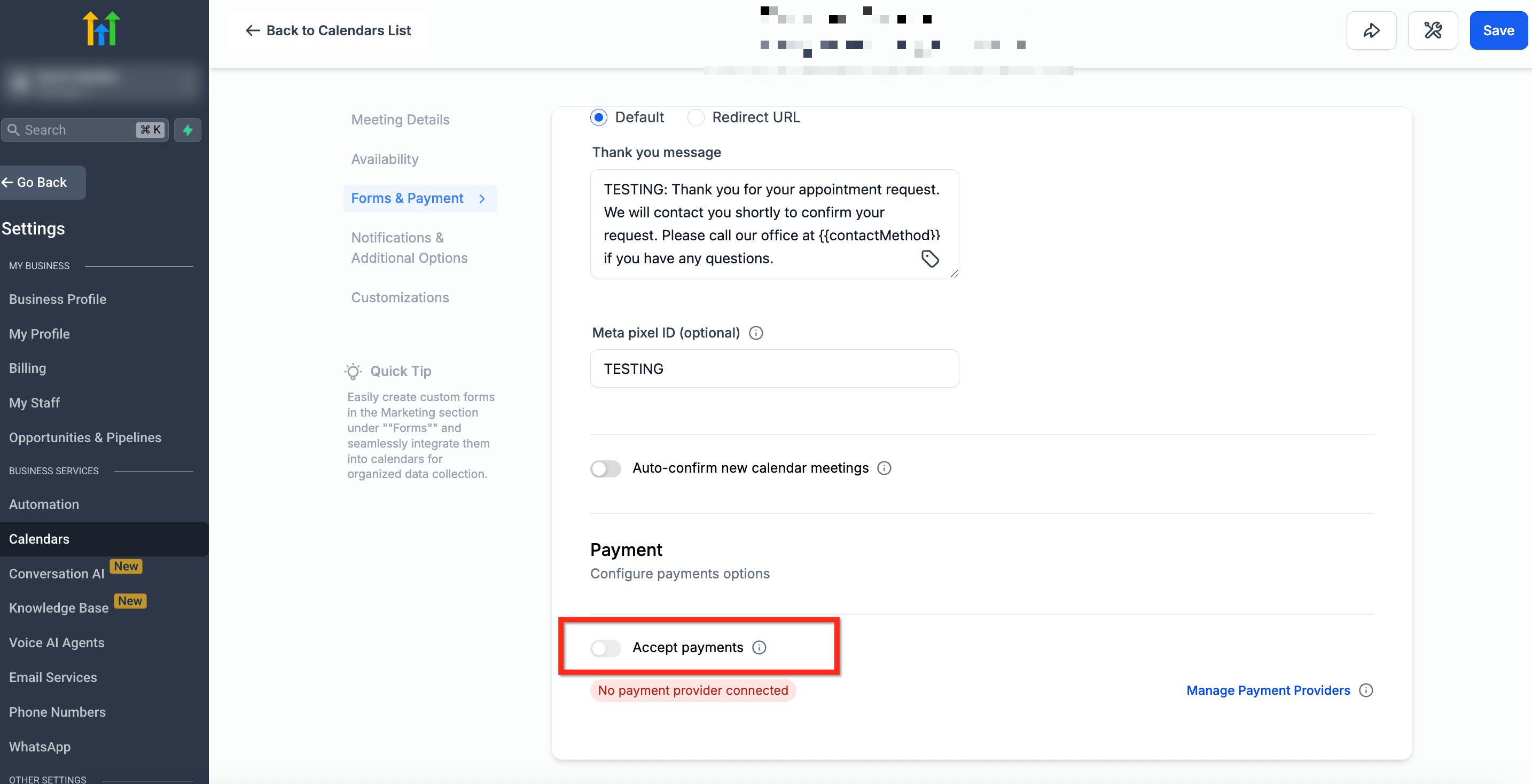
- Scroll down to the Payments section. Enable Accept Payments for all attendees to calculate payment based on the total number of participants.
Require Guests for Booking
This setting is useful for businesses that depend on the participation of more than one individual in each session.
When enabled, the customer cannot proceed with the booking unless the required guest information is provided.
The information collected depends on the calendar's guest configuration. Businesses can collect each guest's name and email, name and phone, name with both email and phone, or only the total guest count.
How Guest Contacts Are Created
When individual guest details are collected, HighLevel automatically creates or matches a contact for each guest using the email address and/or phone number provided during booking.
If Guest Count Only is selected, HighLevel records only the number of guests and does not create individual guest contacts.
Guest Contact Timezones
When HighLevel creates a new guest contact during a booking, the guest inherits the primary contact's timezone.
If the guest already exists as a contact in the CRM, HighLevel keeps that contact's existing timezone unchanged.
Collect Payment for All Attendees
This feature enables businesses to automatically charge the customer based on the total number of attendees, including the primary booker and any added guests.
Instead of charging a fixed fee per booking, the system multiplies the per-person rate by the number of attendees. This provides more accurate billing for services that are priced per participant.
Use cases include:
- Workshops and training events
- Group consultations or treatments
- Restaurant or event bookings
- Any service priced on a per-person basis
How it works:
- The total price is calculated as: Service Price × (1 booker + number of guests)
- The booker is charged the total amount at the time of booking via the connected payment gateway.
Frequently Asked Questions
Q: Can I collect email addresses for each guest?
Yes. You can configure your form to collect guest names and email addresses, which is helpful for sending confirmations and reminders.
Q: Is it mandatory to enable both features?
No. You can enable each setting independently. You may choose to require guests without enabling per-attendee payments, or vice versa.
Q: What happens if a guest cancels but the booker still attends?
Refunds or changes must be handled manually, as the payment is collected based on the booking form at the time of submission.
Q: Do guests receive confirmation emails?
Guests will only receive confirmation emails if their email addresses are collected and guest-specific notifications are configured using workflows or triggers.
Q: Can the booker add multiple guests?
Yes. The booking form supports multiple guest entries. The number of guests can be configured based on your service or appointment type.
Q: What information can I collect for each guest?
You can collect Name & Email, Name & Phone, Name, Email & Phone, or choose Guest Count Only.
Q: Does HighLevel create a contact for each guest?
When guest details are collected, HighLevel creates or matches a contact using the email address and/or phone number provided. If Guest Count Only is selected, individual guest contacts are not created.
Related Articles
Was this article helpful?
That’s Great!
Thank you for your feedback
Sorry! We couldn't be helpful
Thank you for your feedback
Feedback sent
We appreciate your effort and will try to fix the article