The Slack Message workflow action in HighLevel sends automated notifications to people and channels in a connected Slack workspace. You can send a direct message to a user or post updates in a private or public channel when a workflow runs. This premium action helps teams respond to leads, tasks, and business updates without sending each message manually. Learn how to choose a Slack account, configure the action, and manage its connection through Marketplace.
TABLE OF CONTENTS
- What is the Slack Message Workflow Action?
- Key Benefits of the Slack Message Action
- Before You Begin
- Slack Message Action Settings
- How to Set Up the Slack Message Action
- Slack Message Events
- Suggested Workflow Triggers
- Example: Notify a Team About a High-Priority Lead
- Frequently Asked Questions
- Related Articles
What is the Slack Message Workflow Action?
The Slack Message action is a premium action in the HighLevel Workflow Builder that delivers a message to a selected Slack destination when a contact reaches that workflow step. The destination can be an individual Slack user, a private channel, or a public channel. This allows you to share updates from HighLevel workflows with the people who need to act on them.
Action name: Slack Message
Note: Slack Message is a premium workflow action. Premium execution charges may apply after any available allowances are used. See How to Enable and Rebill Workflow Premium Features for current billing and allowance information.
Key Benefits of the Slack Message Action
Automatic Slack messages help teams stay informed about changes in HighLevel without repeatedly checking individual contact records or workflows. Choosing the right destination keeps updates relevant to the person or group responsible for the next step.
- Faster notifications: Send workflow updates to Slack as soon as the configured automation reaches the action.
- Flexible recipients: Deliver messages to an individual user, a private channel, or a public channel.
- Team coordination: Keep sales, support, and operations teams informed of important activities.
- Customizable messages: Include relevant workflow or contact information using supported custom variables.
Before You Begin
A connected Slack account and access to premium workflow actions are necessary before you can configure and use Slack notifications. Confirm the connection and the account's available premium executions to avoid selecting the wrong workspace or encountering unexpected usage charges.
- Connected Slack account: Make sure the intended Slack account is connected to the HighLevel sub-account.
- Workflow access: Open or create a workflow where you want the Slack notification to run.
- Premium features: Confirm that premium workflow features are enabled for the relevant account and review the applicable billing settings.
For connection management, see Connect and Manage Slack Through Marketplace.
Slack Message Action Settings
The action's required fields determine which connected Slack account is used and what type of message the workflow sends. Review these selections before saving the action so the message reaches the intended destination.
 Slack Message action settings in the Workflow Builder.
| Field | Description | Required |
|---|---|---|
| Choose an Account | Select the connected Slack account that will send the message. | Yes |
| Event | Choose whether to send a direct message, a private-channel message, or a public-channel message. | Yes |
How to Set Up the Slack Message Action
The Slack Message action runs as part of a workflow, so both the triggering event and the Slack destination need to be configured correctly. Following this setup order helps ensure that the intended automation sends the correct notification.
- From the relevant HighLevel Sub-Account, go to Automation > Workflows and open an existing workflow or create a new one.
- Add or confirm the workflow trigger that should start the automation.
- In the Workflow Builder, click + to add an action, then search for and select Slack Message.
Choose an Account: Select the connected Slack account you want to use from the dropdown.
For Marketplace connection controls and information about the migration of existing Slack connections, see Connect and Manage Slack Through Marketplace. Existing Slack connections and workflows do not require reconfiguration solely for this migration.
- Event: Select Send Direct Message to a User, Send Private Channel Message, or Send Public Channel Message.
- Select the appropriate user or channel and enter the message content using the fields displayed for that event.
- Save the action, test the workflow with a suitable test record, and publish the workflow when its results are correct.
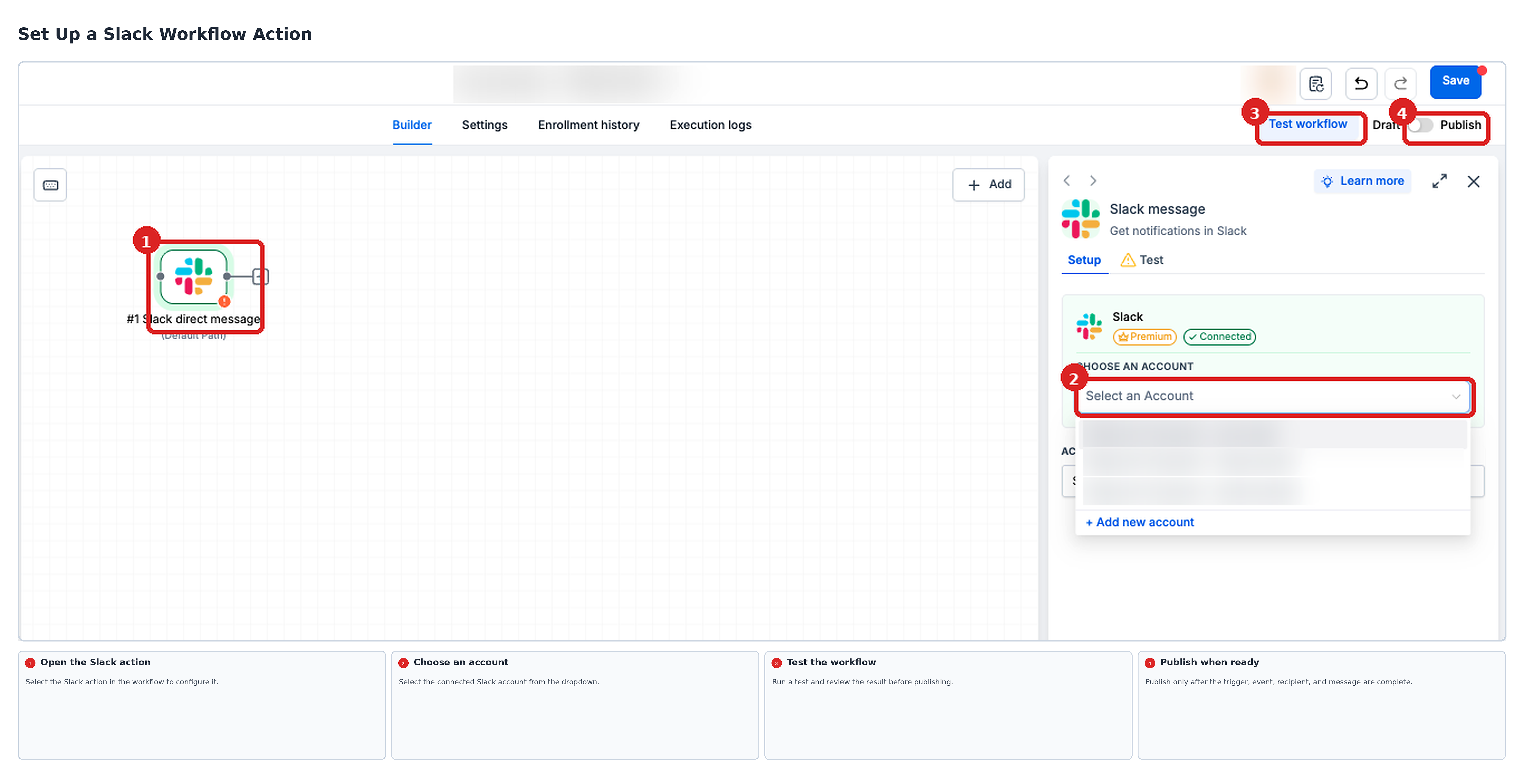
Tip: Test the selected Slack destination and message content before enabling the workflow for live contacts. A successful connection does not by itself confirm that the intended user or channel was selected.
Slack Message Events
Each Slack Message event determines who receives the notification. Choose the event based on whether the message is intended for one person, a restricted team channel, or a public channel in your workspace.
- Send Direct Message to a User: Send a private notification to an individual. The recipient options in the main Slack guide include Assigned User, Custom Email, Internal User, and Slack User.
- Send Private Channel Message: Post to a selected private Slack channel. Messages are sent as the user who established the Slack integration, rather than appearing as the bot.
- Send Public Channel Message: Post to a selected public Slack channel for members with access to that channel.
For recipient selection, channel permissions, and message personalization, see Guide to Slack Workflow Action.
Suggested Workflow Triggers
Pairing Slack notifications with relevant workflow triggers helps teammates receive updates when they need to take action. The appropriate trigger depends on the business event you want to monitor.
- Task added or assigned: Notify a team channel when someone needs to complete a new task.
- Opportunity status changed: Alert a sales channel when an opportunity moves to a new stage or status.
- Form submitted: Notify a team member or channel when a prospect submits a form.
Review A List of Workflow Triggers to select the trigger and filters available for your use case.
Example: Notify a Team About a High-Priority Lead
A Slack notification can help a team respond quickly when a lead meets a priority condition. For example, a marketing team can receive a message when a new lead enters a workflow with the High Priority tag.
Workflow configuration example:
- Trigger:
Contact Added- Filter: Tag =
High Priority
- Filter: Tag =
- Action:
Slack Message- Choose an Account: Your connected Slack account
- Event:
Send Private Channel Message - Channel:
#Marketing Team - Message:
A new high-priority lead has been added. Please check the details.
- Choose an Account: Your connected Slack account
Note: The example assumes the contact meets the High Priority condition when the workflow starts. If the tag is added later, consider using the Contact Tag workflow trigger instead.
Frequently Asked Questions
Q: What if the Slack account I need is not available in the dropdown?
Check that the intended Slack account is connected to the sub-account. Use Connect and Manage Slack Through Marketplace to review the connected-account list.
Q: Do I need to reconnect Slack or rebuild workflows because of the Marketplace migration?
No. Existing connections and workflows do not require reconfiguration solely for the migration. Review the main Slack guide if you need to manage a specific connection.
Q: Why can't I find a particular Slack user or channel?
Confirm that you are using the correct workspace and that the destination is available to the connected account. In large workspaces, the selection list may require the Load More option to display additional users or channels.
Q: Can I include contact information in Slack notifications?
Yes. Where supported in the message editor, use the custom variable picker to insert contact or other relevant CRM information into the message.
Q: Why does a message in a private Slack channel appear to come from a person rather than a bot?
Private-channel messages use the identity of the user who established the Slack integration, as described in the main Slack workflow guide.
Q: Does Slack Message usage incur additional charges?
Slack Message is a premium workflow action. Eligible accounts may have an execution allowance, and charges can apply after the allowance is used or according to the current plan. See How to Enable and Rebill Workflow Premium Features for current details.
Related Articles
Was this article helpful?
That’s Great!
Thank you for your feedback
Sorry! We couldn't be helpful
Thank you for your feedback
Feedback sent
We appreciate your effort and will try to fix the article